Wide Color Gamut: DCI-P3 vs Rec.2020 (2026)
TV boxes love to quote color gamut percentages, but Rec.709, DCI-P3, and Rec.2020 mean very different things. Here is what the numbers really tell you.

Color gamut is the spec that decides whether a sunset looks like a sunset or a smear of orange, and TV makers quote it in percentages that are almost designed to confuse. The trick is knowing which standard the percentage refers to.
Quick answer
Color gamut is the range of colors a display can reproduce. Three standards matter for TVs: Rec.709 for standard HD, DCI-P3 for HDR movies, and Rec.2020, the very wide future target for 4K and 8K. A good HDR TV covers roughly 90 to 98 percent of DCI-P3 but only a fraction of Rec.2020, which no consumer TV fully hits yet. When you shop, look for the DCI-P3 coverage number, because that is the target today's HDR content is mastered against.
Key takeaways
- Three standards stack up: Rec.709 (HD) is smallest, DCI-P3 (HDR) is wider, Rec.2020 is widest.
- DCI-P3 coverage is the number that matters for HDR movies and shows today.
- No consumer TV fully covers Rec.2020, so any 100 percent claim is against a smaller space.
- Wide color needs HDR content to be worth anything; SDR uses the narrow Rec.709 space.
- Read the standard, not just the percent: 95 percent of DCI-P3 beats 95 percent of Rec.709.
The three standards, ranked by size
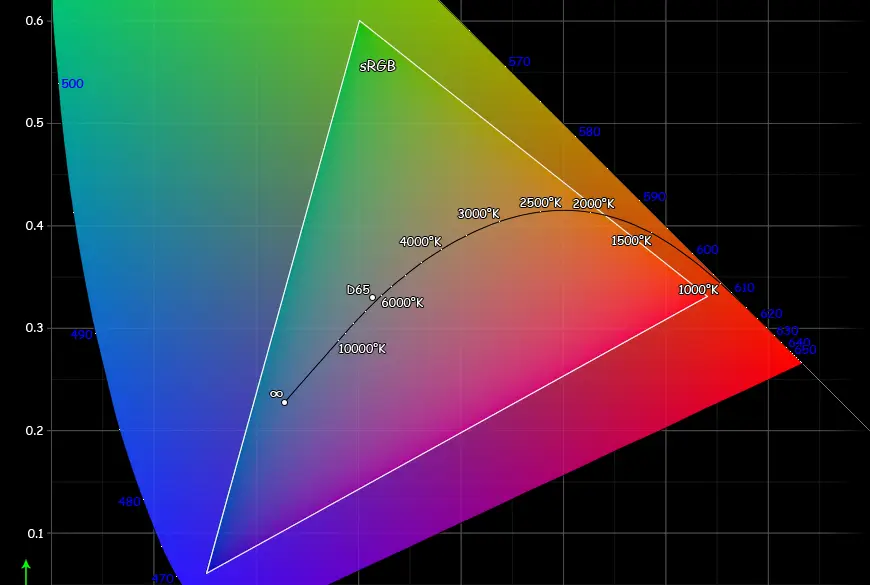
Color gamut is measured as the slice of the visible color space a display can reproduce. The three TV standards are nested, each wider than the last.
Rec.709 dates to 1990 and defines the colors for HD television. It is relatively narrow, covering roughly a third of what the human eye can see. Every SDR broadcast, DVD, and older stream targets it, and any modern TV covers it fully.
DCI-P3 came from the digital cinema world in 2010 and is the working standard for HDR content today. It is noticeably wider than Rec.709, especially in reds and greens, which is why HDR movies show richer, more saturated color. This is the number to care about in 2026.
Rec.2020 is the ambitious future target built for 4K and 8K. It is far larger than DCI-P3, but no current consumer display gets anywhere near full coverage. HDR content is technically flagged as Rec.2020 but mastered within the DCI-P3 region that displays can actually show.
Reading the numbers without getting fooled
The percentage on a spec sheet is meaningless until you know which standard it references. "100 percent color gamut" against Rec.709 is unremarkable, since every TV manages that. The same TV might cover only 80 percent of DCI-P3, which is the number that actually predicts vivid HDR.
| Standard | Introduced | Relative size | What uses it | Realistic TV coverage |
|---|---|---|---|---|
| Rec.709 | 1990 | Smallest | SDR broadcast, DVD, HD streams | 100 percent on any modern TV |
| DCI-P3 | 2010 | Wider | HDR movies and shows | 90 to 98 percent on good HDR TVs |
| Rec.2020 | 2012 | Widest | Future 4K and 8K target | 60 to 80 percent, no full coverage |
So when comparing two TVs, line up their DCI-P3 numbers specifically. A set covering 97 percent of DCI-P3 will render HDR color more completely than one at 88 percent, all else equal.
Why panel technology sets the ceiling
Coverage is a hardware limit, not a setting. To hit wide color, the backlight or emitter must produce pure, saturated primaries. Quantum-dot layers, and now the RGB Mini-LED backlights of 2026, exist largely to push DCI-P3 and Rec.2020 coverage higher by generating purer color. OLED and QD-OLED reach wide color through their self-emissive materials instead.
Wide color also only shows up in HDR. SDR content is authored in Rec.709, so a wide-gamut TV showing an old sitcom uses only the narrow space. If your TV oversaturates SDR to "use" its wide gamut, that is a processing choice, and often an inaccurate one. For faithful color, the display should map each source to its intended space, which is part of why calibrating your HDR TV matters.
What to do right now
To use color gamut in an actual buying or setup decision:
- When comparing TVs, look up the DCI-P3 coverage figure, not a generic percent.
- Treat any Rec.2020 percentage as partial, since full coverage does not exist yet.
- Remember wide color only applies to HDR content; SDR stays in Rec.709.
- If SDR looks cartoonishly vivid, turn off any color-boost mode.
- Pair wide gamut with adequate brightness so highlights actually pop.
- Use Filmmaker or Cinema mode for accurate color mapping out of the box.
Frequently asked questions
Is 100 percent DCI-P3 coverage necessary?
It is a strong target but not a hard requirement. A TV covering the mid-90s of DCI-P3 already shows most HDR color faithfully. The last few percent are hard for the eye to notice, so do not overpay for it if other traits like brightness or black level matter more to you.
Why does no TV cover 100 percent of Rec.2020?
Rec.2020 uses extremely pure primary colors that current backlights and emitters cannot fully produce. It was designed as a long-term target, so coverage climbs each generation but no consumer display reaches full range yet. Marketing that implies otherwise is measuring against a smaller space.
Does a wide color gamut make SDR look better?
Not by itself. SDR content is authored in the narrow Rec.709 space, so a wide-gamut TV simply displays it within that range. Some TVs stretch SDR into wider color to look punchy, but that is an inaccurate effect, not a benefit of the panel.
What is the difference between color gamut and HDR?
Color gamut is the range of colors, while HDR is about the range of brightness and how highlights and shadows are handled. They work together in HDR content, but they are separate specs. A TV can have wide color yet mediocre brightness, or the reverse.