Fix Dual-Monitor Scaling on Windows 11
Make a 1080p and a 4K monitor look right together on Windows 11 by setting per-monitor scaling so text stays the same physical size.
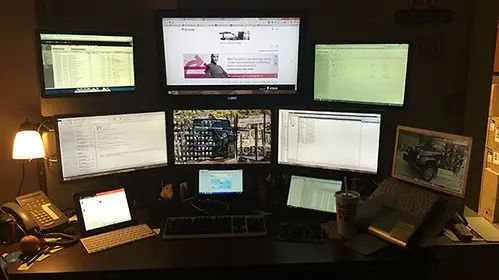
Pairing a 1080p monitor with a 4K one is one of the most common desk upgrades, and one of the most frustrating, because Windows 11 will happily make one screen's text microscopic and the other's enormous. The fix is not a setting most people know to look for: per-monitor scaling, where each display runs its own scaling percentage so text ends up the same physical size on both.
Quick answer
Open Settings then System then Display, click each monitor in the diagram, and set its resolution to native first. Then select each monitor individually and give it its own Scale percentage, typically 100% on a 1080p panel and 150% or 175% on a 4K panel, until text looks the same physical size on both. Arrange the monitor boxes to match your real layout, and update your GPU driver if windows blur when dragged across screens. The whole process takes about ten minutes.
Key takeaways
- Set each monitor to its native resolution first; everything else fails if the resolution is wrong.
- Apply different scaling percentages per monitor, not the same one. This is the step almost everyone misses.
- Aim for matching physical text size, often 100% on 1080p and 150-175% on 4K.
- Arrange the monitors in Display settings to match their real-world positions so the cursor crosses at the right edge.
- Keep Windows and graphics drivers updated to avoid blur and redraw glitches when dragging windows between screens.
Why this happens at all
Scaling is about pixel density, not screen size. A 27-inch 1080p panel spreads about 81 pixels into every inch, while a 27-inch 4K panel packs roughly 163 pixels into that same inch. If both run at 100% scale, a block of text that is comfortable on the 1080p screen becomes half the physical height on the 4K screen, because each pixel is physically smaller there. Windows 11 supports a different scale value per display precisely so you can compensate. The goal is never matching percentages; it is matching how big a letter actually looks when you sit back.
Set native resolution on each monitor
Open Settings then System then Display. Click each monitor in the diagram and set its Display resolution to the recommended (native) value, usually the highest listed. A non-native resolution looks soft, introduces interpolation blur, and makes scaling problems worse, so fix this before touching scaling.
Set per-monitor scaling
This is the key step most people miss. Windows 11 applies scaling only to the selected monitor.
- In Display settings, click the first monitor in the diagram to select it.
- Under Scale, choose the recommended percentage (often 100% for a 1080p panel).
- Click the second monitor to select it.
- Set its scale independently (often 150% or 175% for a 4K panel).
- Drag a window between the screens to confirm text looks the same physical size.
The goal is not matching percentages; it is matching how big text actually looks. A 4K monitor packs far more pixels, so it needs a higher percentage to make text the same size as a 1080p screen.
Tip
After changing scaling, sign out and back in for some older apps to redraw cleanly. Apps that look blurry at the new scale may need to be closed and reopened.
Recommended scaling by panel and size
Use this as a starting point, then nudge by 25% until text looks right at your actual viewing distance.
| Panel resolution | Size | Suggested scale | Notes |
|---|---|---|---|
| 1920x1080 | 24-27 in | 100% | The baseline most people anchor to |
| 2560x1440 | 27 in | 100-125% | 125% if you sit close |
| 3840x2160 (4K) | 27 in | 150% | Very common pairing with 1080p |
| 3840x2160 (4K) | 32 in | 125-150% | Larger panel needs slightly less |
| 3440x1440 ultrawide | 34 in | 100-125% | Wide, not dense |
Arrange monitors to match reality
In the same settings page, drag the numbered monitor boxes so their on-screen arrangement matches your physical layout, for example placing monitor 2 above or to the left of monitor 1. This makes your mouse cross between screens at the right edge instead of jumping awkwardly. While you are here, you can also drag the small bar that marks the main display onto whichever monitor you want as primary, and set top or bottom alignment so the cursor does not "catch" on a corner when you move between mismatched-height screens.
Fix leftover glitches
Most remaining problems are blur, delayed redraws, or a window resizing as it crosses the boundary. Here is how to read each symptom.
| Symptom | Likely cause | Fix |
|---|---|---|
| Window blurs after crossing screens | Older app not DPI-aware | Close and reopen it; check for an app update |
| Text fuzzy on one monitor at all times | Non-native resolution set | Set Display resolution to recommended |
| Window resizes when dragged across | Normal per-monitor scaling behavior | Expected; no fix needed |
| Cursor "jumps" to wrong screen | Monitor boxes misarranged | Drag boxes to match physical layout |
| Scaling glitches after sleep/wake | GPU driver or Windows bug | Update GPU driver and Windows |
If a window blurs or jumps when crossing screens, update your graphics driver (NVIDIA, Intel, or AMD) and install pending Windows updates, which resolve many per-monitor scaling bugs. Slight resizing as a window crosses is normal; persistent blurring or delayed redraws point to a driver or app that needs updating or restarting.
If a second monitor is not detected at all, that is a connection issue rather than scaling. Our guide to a second monitor not being detected covers the cable and port side, USB device not recognized errors handles dock and adapter problems, and for sluggish redraws overall, see fixing 100% disk usage on Windows 11.
What to do right now
- Set each monitor to its recommended (native) resolution in Display settings.
- Click the 1080p monitor and set Scale to 100%.
- Click the 4K monitor and set Scale to 150% (or 125-175% to taste).
- Drag a window of text from one screen to the other and check the letters look the same size.
- Drag the monitor boxes to match your physical arrangement and set your primary display.
- Update your GPU driver and install pending Windows updates if anything blurs or lags.
Frequently asked questions
Why is text tiny on one monitor and huge on the other?
Because they have very different pixel densities but the same scaling percentage. Set a higher scale on the high-resolution monitor so text matches the physical size on the lower-resolution one.
What scaling should I use for a 4K and 1080p combo?
A common pairing is 100% on the 1080p screen and 150% or 175% on the 4K screen, but adjust until text looks the same size on both. Use the recommended value as a starting point.
Why do windows blur when I drag them between monitors?
That happens with per-monitor scaling when an older app does not redraw cleanly. Update graphics drivers and Windows, and close and reopen the app. Modern apps handle the transition smoothly.
How do I make my mouse cross screens in the right place?
Drag the monitor boxes in Display settings to match your physical arrangement. If the right monitor sits to your right, place box 2 to the right of box 1, and the cursor will cross at that edge. Align the boxes top-to-top so the cursor does not snag on a corner.
Should both monitors run the same refresh rate?
They do not have to, and mixing a 144Hz and a 60Hz panel works fine. Set each monitor's refresh rate in Advanced display under Display settings. Mismatched refresh rates do not affect scaling, though some games behave better when your primary display is the higher-refresh one.
Sources & further reading
- windowscircle.com/en-us/windows-11/dual-monitor-scaling
- geekchamp.com/fix-dual-monitors-with-different-resolutions-in-windows-11/
- thewindowsclub.com/how-to-set-different-display-scaling-level-for-multiple-monitors-in-windows-10
- digitaltrends.com/computing/common-multi-monitor-problems-and-how-to-fix-them/
- support.microsoft.com/en-us/windows/how-to-use-multiple-monitors-in-windows-329c6962-5a4d-b481-7baa-bec9671f728a